
Biogas electricity generation spans a wide range of scales, from single-farm digesters powering a household to interconnected community microgrids serving hundreds of homes. This article examines the technical and economic realities at each level, drawing on documented projects in Jamaica, Uganda, and rural Asia. It then introduces the GASCHEK1000 portable biogas analyzer and explains why gas quality monitoring is not optional but essential when biogas is fed to an engine rather than a stove.
Introduction
Burning biogas in a stove is forgiving. An engine is not. When biogas is fed into an internal combustion generator, the tolerances tighten dramatically: hydrogen sulfide corrodes bearings, moisture fouls lubricating oil, and low methane content means unstable combustion and lost power output. The same gas that cooks a meal adequately may destroy a generator within months if left untreated.
This distinction matters because electricity generation is where biogas’s value proposition becomes most economically interesting—and most technically demanding. At the farm scale, a generator converts waste into both power and heat, displacing diesel or grid purchases. At the community scale, interconnected digesters and generators can form the backbone of a decentralized energy system where the national grid has failed to reach. Between these two poles lies a spectrum of configurations, each with its own engineering constraints and monitoring needs.
Farm-Scale Generation: The Household and Smallholding Level
- Technical Performance and Practical Limits
The smallest viable scale of biogas electricity generation is a single farm or rural household. An IEEE conference paper published in early 2026 describes an IoT-integrated system using cow dung as feedstock. The digester produced 300 liters of gas continuously over a 15-day period, and the generator achieved a peak output of 450 watts at 84% efficiency—described by the authors as “the ideal amount of power demand for a rural family”. The system also incorporated real-time gas composition monitoring and a filtration step using locally available materials to strip hydrogen sulfide before the gas reached the engine .
This example illustrates both the promise and the ceiling of farm-scale generation. Four hundred fifty watts is sufficient for lighting, phone charging, a small television, and perhaps a fan. It is not sufficient for refrigeration, irrigation pumping, or productive enterprises. The efficiency figure of 84% likely refers to the generator’s conversion of the gas’s energy content under optimized laboratory or controlled conditions; real-world performance depends heavily on gas quality and load consistency.
- The Cost Case for Farm-Scale Generation
A study examining a retrofitted 32 kW generator provides a more commercially relevant data point. When the system ran on biogas partially cleaned of undesirable components, the researchers recorded a 60% cost reduction compared with using petrol . The study’s warning is equally important: hydrogen sulfide, CO₂, and water vapor in biogas “posed a serious threat to the engine performance as well as the life span of the engine”. The recommendation was explicit—refining the gas through desulfurization, condensation, and carbonization before it reaches the engine .
The economic logic here is straightforward. A farm that already has a digester for waste management can add a generator and displace purchased fuel. The capital cost of the generator is offset by fuel savings over time. But the savings only materialize if the engine survives. That requires gas treatment, and gas treatment requires knowing what is in the gas.
Community Power Systems: Beyond the Single Farm
- Mesh Grids and Hybrid Architectures
The step from farm-scale to community-scale generation is not simply a matter of building a bigger digester. It requires a different conception of the energy system itself. A FAO project in Jamaica, implemented in 2025, piloted “mesh-grid” systems: decentralized networks where small clusters of households and farms are interconnected by low-voltage lines to share power generated from solar PV and biogas . The biogas component, derived from poultry manure and other agricultural residues, provided nighttime baseload generation, while solar covered daytime demand and batteries discharged overnight .
The simulation results for a system comprising approximately 850 households were striking: 5,692 MWh of annual generation, a generation cost more than four times lower than the grid tariff, a 78% reduction in household electricity costs, and 3,038 tonnes of CO2 -equivalent savings . These figures are modeled projections rather than measured outcomes, but they indicate the magnitude of the opportunity when biogas is integrated into a deliberately designed community energy architecture rather than treated as an isolated household appliance.
A similar conclusion emerges from Uganda. A solar PV-biogas hybrid microgrid pilot serving seven end users has been operating since April 2024. The financial analysis found the hybrid system viable with positive internal rate of return, net present value, and return on investment—whereas solar PV alone was not . Biogas’s dispatchable nature, available when the sun is not, is what makes the economics work.
- The Critical Role of Gas Treatment at Community Scale
At community scale, the consequences of poor gas quality multiply. A single generator serving dozens of households cannot be taken offline for corrosion repairs without disrupting service. The FAO mesh-grid design explicitly treats biogas as a baseload resource, meaning the generator must run reliably night after night .
The technical literature is consistent on what this requires. For internal combustion engines in combined heat and power configurations, H2S content must be controlled to below 250 ppm to avoid corrosion of boiler components and lubricating oil. A review of biogas utilization technologies notes that engines tolerate higher moisture and H2S levels than fuel cells but still require removal to prevent damage . A purification study demonstrated that reducing H₂S from typical levels of 0.1–3% (1,000–30,000 ppm) to below 0.01% (100 ppm) meets the limit for internal combustion engines, preventing corrosion and SO₂emissions .
The gap between raw biogas and engine-grade biogas is not a minor polishing step. It is the difference between a system that operates for years and one that fails within months.
The GASCHEK1000 in Electricity Generation Applications
- Why Monitoring Changes the Economics
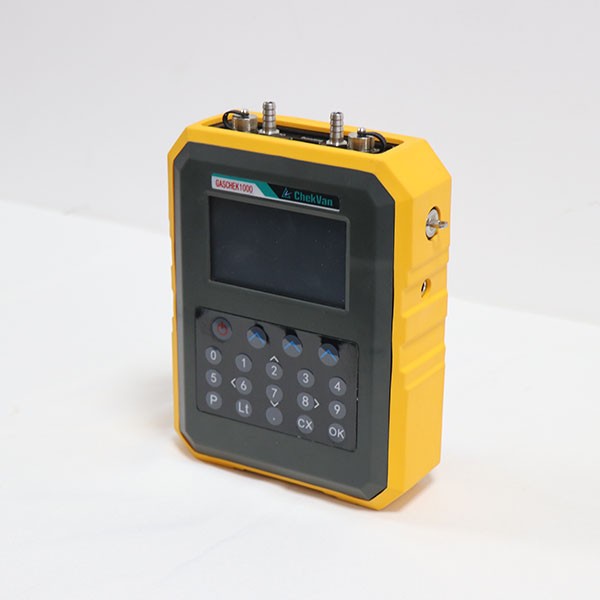
The GASCHEK1000 portable biogas analyzer
The GASCHEK1000 portable biogas analyzer measures CH4, O2, CO2, and H2S simultaneously, using a laser sensor for the methane channel. For electricity generation applications, the relevance of each channel is direct:
CH4 determines the energy content delivered to the engine. A drop from 65% to 55% methane means roughly 15% less energy per cubic meter, which translates to reduced power output or increased fuel consumption for the same load. Without measurement, this degradation is invisible until performance has already declined.
H2S is the engine killer. The 250 ppm threshold cited in the CHP literature is not an abstraction; it is the concentration above which corrosion accelerates and oil degradation compounds. Periodic H2S readings allow operators to schedule desulfurization media replacement before damage occurs, rather than after.
O2 detection in biogas is almost always a sign of air ingress—a leak in the gas line or a problem with the digester seal. For an engine, oxygen in the fuel stream can cause knock and unstable combustion. For safety, it indicates a flammable gas leak.
CO2 provides a cross-check on digester performance. Rising CO2 alongside falling CH4 is a classic signature of acidification or overloading, telling the operator to adjust feed before the gas quality reaches a point where the engine stalls.
- Practical Deployment at Digester Sites
The instrumen’s design features align with the realities of farm and community digester operations. Battery life exceeding 19 hours covers a full inspection route across multiple digesters or sampling points without recharging. The resistive touchscreen works with gloves in the messy, humid environment of a digester yard. Storage for 360,000 data sets with QR-code identification means each reading is tagged to a specific location and time, building a record that can be correlated with engine performance logs, feedstock changes, and maintenance events.
For community systems specifically, the ability to compare gas quality across multiple digesters feeding a shared generator is valuable. If one digester consistently produces gas with higher H2S than others, the feedstock mix for that digester can be adjusted, or its gas routed through additional treatment before blending. This kind of differential diagnosis is impossible with a single fixed monitoring point at the generator inlet.
- The Verifiable Claim
The manufacturer lists agricultural and farm waste digestion among the GASCHEK1000’s primary applications. A user feedback comment from an agricultural biogas research institute, cited on the manufacturer’s site, notes “very durable battery and even better accuracy”compared with a previously used European instrument. For a device intended to be carried between digesters and engines, battery durability and reading stability are not secondary considerations—they determine whether monitoring actually happens or is skipped when inconvenient.
The Economic and Policy Context
Biogas electricity generation does not exist in a policy vacuum. Feed-in tariffs, capital subsidies, and carbon pricing mechanisms directly determine whether a project achieves positive net present value . The FAO Jamaica analysis found that the modeled mesh-grid system achieved a generation cost four times lower than the grid tariff , but that result depends on the specific tariff structure and capital cost assumptions of that context.
A more sobering assessment comes from a 2026 commentary in Frontiers of Environmental Science & Engineering. Biogas accounted for only 0.5% of newly installed global renewable electricity capacity in 2024, while wind and solar took 96.6% . The levelized cost of electricity from biogas in Germany in 2024 was 20.2–32.5 euro cents per kWh, compared with 4.3–10.3 cents for wind and 4.1–6.9 cents for utility-scale solar . The authors argue that biogas should be strategically reassessed not as a primary energy source but as a niche solution for waste management, seasonal storage, and grid balancing .
This does not diminish the case for farm-scale and community-scale biogas electricity. It clarifies it. Biogas electricity makes sense where the feedstock is already being managed as a waste stream, where the alternative is diesel or no electricity at all, and where the co-benefits—waste treatment, odor control, fertilizer production—are counted alongside the kilowatt-hours. In those contexts, the GASCHEK1000’s role is to protect the investment by ensuring the engine receives gas it can actually burn.
Biogas electricity generation at the farm and community scale is technically proven and economically viable under the right conditions. A 450-watt household system, a 32 kW farm generator with 60% fuel cost savings, and a modeled 850-household mesh grid with 78% lower electricity bills all demonstrate the range of what is possible . What unites these cases is a common vulnerability: the engine is the most expensive component in the system, and it is the component most easily destroyed by poor gas quality.
The GASCHEK1000 does not generate a single watt of electricity. What it does is make visible the variables—methane content, hydrogen sulfide concentration, oxygen ingress—that determine whether the generator runs for years or fails in months. In a technology area where the economics are already marginal and policy support is uncertain, that visibility is not a luxury. It is the difference between a project that delivers on its promise and one that becomes a cautionary tale.
About ChekVan Tech
Since the foundation of Chekvan Tech, it has endeavored to be an qualified manufacturer and supplier of portable biogas analyzers, online biogas monitoring system, fixed gas detectors for biogas plants around the world. We also develop and builds microflow biogas analyzer and gas blender for universities and researching facilities on biogas research.
To learn more, please don’t hesitate to contact us via email at sales@chekvan.com, or visit our website at www.chekvan.com.

