

The high moisture content and easy acidification characteristics of kitchen waste pose stability challenges for anaerobic digestion, but through co-digestion blending, pretreatment optimization, and process monitoring, methane production efficiency can be significantly improved. This paper systematically reviews the technical optimization pathways for anaerobic digestion of kitchen waste and illustrates its environmental and economic benefits with reference to actual engineering data. On this basis, it focuses on the technical characteristics of the GASCHEK1000 portable biogas analyzer—laser CH₄sensing, simultaneous multi-gas detection, over 19 hours of battery life, and storage capacity for 360,000 data sets—and its practical value in routine inspection and process diagnosis at kitchen waste digestion facilities.
1 Introduction
Urban kitchen waste—including food service residues and household perishable waste—is a major component of organic solid waste. Its high organic content, rapid decomposability, and strong odor make it an environmental burden when improperly handled; viewed from another angle, however, high organic content precisely means considerable energy recovery potential. Anaerobic digestion converts kitchen waste into biogas and is a mainstream technical pathway for achieving “waste-to-energy” conversion.
Yet anaerobic digestion of kitchen waste is not without obstacles. Its carbon-to-nitrogen ratio is low (about 13:1), and its oil, grease, and salt content are relatively high; when digested alone, it acidifies very easily, inhibiting methanogen activity and reducing gas production rates. How to overcome these bottlenecks through process design and process control is key to whether kitchen waste biogas projects can operate stably. At the same time, refined management of the digestion process cannot be separated from reliable gas monitoring means. The GASCHEK1000 portable biogas analyzer is precisely a field tool designed for this need.
2 Technical Optimization Pathways for Anaerobic Digestion of Kitchen Waste
2.1 Co-digestion: Adjusting C/N Ratio and Buffering Capacity
The core problems of digesting kitchen waste alone are C/N ratio imbalance and insufficient buffering capacity. Studies have shown that mixing kitchen waste with materials having higher C/N ratios for co-digestion can effectively improve system stability. A team from the Shanghai Advanced Research Institute of the Chinese Academy of Sciences added kitchen waste or garden waste to thermophilic anaerobic digestion of food waste for co-digestion; results showed that when food waste and kitchen waste were combined at a 60:40 ratio, gas production increased by 73.33% compared with the food-waste-only group. Another study on co-digestion of kitchen waste and cow dung found that the cumulative biogas production of the co-digestion group reached 257.4 L, about 36.5% higher than kitchen waste digested alone (188.6 L), with methane concentration increasing from 59.6% to 67.2%. The value of co-digestion lies not only in diluting inhibitors but also in enriching key hydrolytic bacteria and hydrogenotrophic methanogens through material complementarity, strengthening gas production performance at the microbial ecology level.
2.2 Pretreatment and Process Intensification
The goal of kitchen waste pretreatment is to improve material homogeneity and biodegradability. In engineering practice, “multi-stage plunger extrusion pretreatment” can raise the solid residue’s total solids content to 36.9%, with organic slurry COD of about 113,000 mg/L, providing suitable feed conditions for subsequent anaerobic digestion. In terms of process intensification, adding functional materials has been a research hotspot in recent years. Iron oxide-modified digestate-derived biochar has shown potential in high-load semi-continuous digestion to regulate microbial communities and activate key methanogenic metabolic pathways. In addition, eggshell as an acidogenesis regulator can increase total volatile fatty acid concentration by more than 2.5 times, with acetic acid accounting for a stable ~79%, offering a new approach for flexible gas production in two-phase anaerobic digestion.
2.3 Gas Production Performance in Engineering Cases
Measured data from a large urban comprehensive waste disposal project in Tianjin provide an engineering reference for anaerobic digestion of kitchen waste: after pretreatment and the anaerobic digestion system, COD removal rate was about 89.5%, methane content in biogas was about 61.6%, and unit treatment cost was about 231.7 yuan/ton. This methane concentration level falls within the normal range for kitchen waste digestion biogas, but still leaves room for improvement toward theoretical values, illustrating the necessity of continuous process optimization and refined monitoring.
3 Application of GASCHEK1000 in Kitchen Waste Digestion Monitoring
3.1 Technical Characteristics and Field Adaptability
The GASCHEK1000 portable biogas analyzer uses photoelectric sensing principles and can simultaneously detect methane (CH4), oxygen (O2), carbon dioxide (CO2), and hydrogen sulfide (H2S). Its CH4 channel uses a laser sensor, featuring fast response, stable readings, and strong anti-interference capability. The instrument explicitly lists “anaerobic digestion of mixed kitchen waste” as one of its application scenarios, directly corresponding to the subject discussed in this paper.
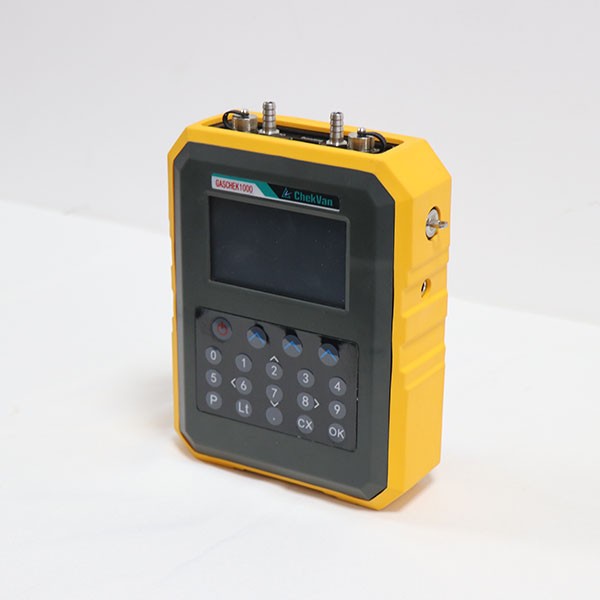
The GASCHEK1000 portable biogas analyzer
From a field operation perspective, several design features of the instrument are particularly practical for kitchen waste digestion facilities. The resistive touchscreen supports gloved operation, adapting to the high-humidity, odorous environment of pretreatment workshops and digester tank areas. The built-in lithium battery provides over 19 hours of continuous operation, sufficient to cover the daily inspection route of a medium-sized digestion facility. Storage capacity for 360,000 data sets and QR code scanning for identification enable multi-point, long-term monitoring records without relying on manual logbooks, preserving a structured basis for subsequent data retrieval and process analysis.
3.2 Gas Quality Diagnosis and Basis for Process Adjustment
In the daily operation of kitchen waste digestion facilities, CH4 concentration is the most direct indicator of digestion status. Engineering data show CH4 content of about 61.6% under normal operating conditions; if portable analyzer readings remain persistently below this level while CO2 proportion rises, operators should first investigate whether feed load is too high or an acidification tendency has emerged. H2S readings reflect the intensity of sulfur-containing protein decomposition and sulfate reduction activity; kitchen waste has relatively high protein content (about 11.83% TS), and abnormally elevated H2S concentration not only indicates process fluctuation but also serves as an early warning signal for pipeline and equipment corrosion risk. Unexpected O2 detection points to pipeline sealing problems or air ingress during sampling operations, requiring timely handling.
Another irreplaceable aspect of portable analyzers is their diagnostic capability in the spatial dimension. Differences in gas data from different sampling ports of the same digestion facility can help locate mixing dead zones or localized acidification areas; lateral comparison between different digesters helps determine whether problems are systemic or specific to individual reactors. Such information is difficult for fixed online monitoring points to provide.
3.3 Data Accumulation Supporting Long-term Optimization
The feed properties of kitchen waste digestion facilities fluctuate with season, source, and sorting quality, and the “optimal values” of process parameters are not fixed. The data storage and transmission functions of the GASCHEK1000 enable operators to correlate daily inspection CH4, CO2, and H2S readings with feed records and temperature logs, gradually accumulating the facility-specific “operation–response” experience curve. For small and medium-sized kitchen waste treatment stations lacking dedicated technical teams, this low-barrier, traceable data collection approach is a pragmatic starting point for moving process management from “by feel” to “by data.” According to user feedback, the instrument has demonstrated good battery durability and accuracy stability at biogas project sites, meeting routine process monitoring needs.
Anaerobic digestion of kitchen waste for biogas plays a dual role in urban organic waste management: it is both a means of waste reduction and stabilization and a mode of distributed renewable energy production. Its technical success depends largely on anticipating acidification risk and continuously perceiving digestion status. The significance of the GASCHEK1000 portable biogas analyzer lies not in replacing online monitoring systems, but in delivering key gas indicators from the laboratory to the operating site—when inspection personnel can read subtle changes in CH4 concentration beside the digester every day and adjust feed or mixing strategies accordingly, the stable operation of kitchen waste biogas projects gains a layer of practical assurance.
About ChekVan Tech
Since the foundation of Chekvan Tech, it has endeavored to be an qualified manufacturer and supplier of portable biogas analyzers, online biogas monitoring system, fixed gas detectors for biogas plants around the world. We also develop and builds microflow biogas analyzer and gas blender for universities and researching facilities on biogas research.
To learn more, please don’t hesitate to contact us via email at sales@chekvan.com, or visit our website at www.chekvan.com.

