
As biogas becomes an increasingly important renewable energy source, accurate measurement is essential for efficient system operation, performance optimization, and environmental compliance. Whether you are running a small-scale digester on a farm or managing a large industrial biogas plant, understanding the measurement units used in biogas analysis is key to interpreting data and improving process control.
This article explains the most commonly used biogas measurement units, how they relate to gas composition and energy output, and why precise monitoring is vital throughout the biogas production process.
Why Measuring Biogas Matters
Biogas production involves the anaerobic digestion of organic waste, which generates a mixture of gases—primarily methane (CH₄), carbon dioxide (CO₂), and small quantities of other gases such as hydrogen sulfide (H₂S) and oxygen (O₂). Each of these gases affects the energy content, safety, and efficiency of the system.
To maintain a stable and productive digester, operators must regularly monitor:
Gas volume produced
Gas composition
Methane content (for energy calculation)
Toxic or corrosive gases (like H₂S)
Common Biogas Measurement Units
1. Volume Units
These units quantify the amount of biogas produced:
Cubic meters (m³): The most common unit for daily or hourly gas production in medium-to-large plants.
Liters (L): Used for smaller digesters or laboratory-scale studies.
Cubic feet (ft³): Common in countries using imperial units, especially in North America.
Volume can be reported under:
Standard Temperature and Pressure (STP) conditions for consistent comparison.
Actual conditions, which vary with temperature and pressure.
2. Concentration Units
Used to express the composition of individual gas components in the biogas:
Percent by volume (% vol): Methane, CO₂, O₂, and H₂S concentrations are often expressed as a percentage of total gas volume.
Parts per million (ppm): Used for trace gases like H₂S and O₂ that can affect corrosion and microbial health even at low concentrations.
Example:
CH₄ = 60% vol
CO₂ = 35% vol
H₂S = 500 ppm
3. Energy Units
Used to calculate the energy content of biogas based on its methane concentration:
Kilowatt-hours (kWh): Measures the electricity potential from combusting biogas.
Megajoules (MJ) or British Thermal Units (BTU): Measure thermal energy content.
Approximate energy value of biogas with 60% methane:
6 kWh/m³
21.6 MJ/m³
600 BTU/ft³
4. Flow Rate Units
Used to measure the rate of gas production over time:
Cubic meters per hour (m³/h)
Liters per minute (L/min)
Standard cubic feet per minute (SCFM)
Flow measurement helps operators understand system dynamics and make adjustments to feedstock input or temperature control.
Gas Monitoring and Analysis
Gas monitoring is essential to ensure safe, efficient, and optimized operation of a biogas plant. Biogas analyzers measure the concentration of gases in real-time and alert operators to imbalances or potential problems in the digestion process.
Gas monitoring: Biogas analyzers, such as the GASCHEK1000 portable biogas analyzer, use advanced photoelectric sensing principles to detect and analyze methane (CH₄), oxygen (O₂), carbon dioxide (CO₂), hydrogen sulfide (H₂S) and other gases, and accurately report, while effectively checking the digestive process.
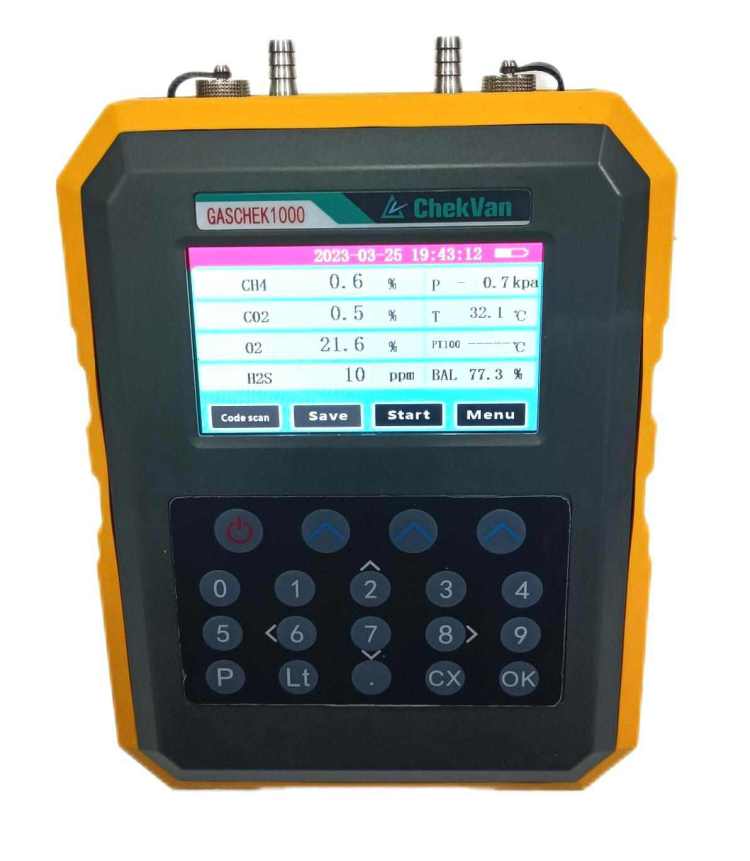
the GASCHEK1000 portable biogas analyzer
Such analyzers help in:
Fine-tuning organic loading rates
Preventing process acidification
Maintaining gas purity for power generation or grid injection
Protecting engines and equipment from corrosion
Practical Applications of Measurement Data
Accurate measurement and unit interpretation allow operators to:
Optimize energy output: Adjust feedstock to maximize methane yield.
Verify system performance: Compare actual gas production to theoretical potential.
Plan energy use: Calculate how much gas is needed for cooking, heating, or running a generator.
Report to regulators: Many jurisdictions require reporting methane production and emissions in specific units.
Understanding biogas measurement units—from volume and flow to concentration and energy content—is crucial for anyone involved in biogas production. Proper monitoring and analysis not only ensure operational safety but also maximize efficiency and profitability.
With tools like the GASCHEK1000 portable biogas analyzer, plant operators can rely on precise, real-time gas readings to manage the complex biology of anaerobic digestion and turn waste into consistent, clean energy. As biogas continues to grow as a renewable energy solution, mastering these measurements will remain a core part of sustainable energy management.
 Manufacturer of biogas analyzer, landfill gas analyzer and extraction monitor, anaerobic digester gas analyzer