

Biogas, a renewable energy source produced through the anaerobic digestion of organic waste, has long been used for electricity generation and heating. However, its potential as a versatile fuel extends beyond electricity. One of the most innovative applications of biogas is its conversion into Liquefied Petroleum Gas (LPG), which is commonly used for cooking, heating, and industrial applications.
Converting biogas into LPG is an exciting process that not only increases the versatility of biogas but also enhances its storage and transportation options. In this step-by-step guide, we will explore how biogas can be converted into LPG, the technology involved, and the benefits of doing so.
1. Understanding the Components of Biogas and LPG
Biogas is primarily composed of methane (CH₄), carbon dioxide (CO₂), and small amounts of other gases like hydrogen sulfide (H₂S) and water vapor. The methane content is what gives biogas its energy potential.
LPG (Liquefied Petroleum Gas) is a mixture of propane (C₃H₈) and butane (C₄H₁₀) that has been liquefied under pressure. It is a portable, clean-burning fuel used widely in residential, commercial, and industrial applications.
Since biogas is predominantly methane, the goal is to refine and compress the methane to a level where it mimics the properties of LPG.
2. Purifying Biogas
The first step in converting biogas into LPG is purification. Raw biogas contains impurities such as carbon dioxide, hydrogen sulfide, water vapor, and other trace gases, which need to be removed before it can be liquefied or even used as a fuel.
a. Removing Hydrogen Sulfide (H₂S):
Hydrogen sulfide is a corrosive gas that can damage equipment and pose environmental hazards. It is typically removed using one of the following methods:
Iron sponge: A chemical process where iron oxide reacts with hydrogen sulfide, producing iron sulfide.
Adsorption: Using activated carbon or specialized adsorbents to capture hydrogen sulfide.
b. Carbon Dioxide (CO₂) Removal:
Carbon dioxide dilutes the methane content of biogas and needs to be separated. The most common methods for CO₂ removal are:
Water scrubbing: CO₂ dissolves in water, separating it from the methane.
Pressure swing adsorption (PSA): A method where pressure changes are used to separate CO₂ from methane.
Membrane separation: Using selective permeable membranes that allow methane to pass through while trapping CO₂.
c. Drying the Biogas:
Biogas is typically saturated with water vapor, which needs to be removed to prevent equipment corrosion and ensure proper functioning of downstream equipment. Condensation systems or desiccants are commonly used to dry biogas.
After purification, the biogas should have a high methane concentration (usually above 95%) and be free from harmful impurities.
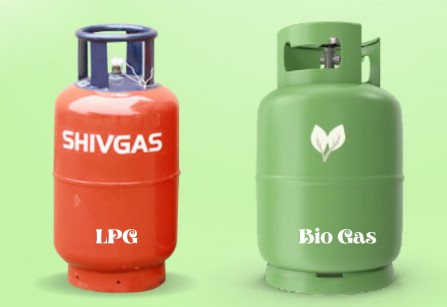
3. Compressing Biogas to LPG-Like Pressure
a. Compression:
Compression is the key step to converting biogas into a liquefied form. Biogas is compressed using high-pressure compressors to pressures of around 8–10 MPa (80–100 bar), which is similar to the pressure at which LPG is stored.
This high pressure causes the biogas (methane) to liquefy, making it more manageable for storage and transportation.
b. Cooling:
To further assist in the liquefaction of biogas, the compressed biogas is often cooled. Although methane remains gaseous at room temperature, cooling it before compression can help with the liquefaction process.
Methane liquefies at temperatures below -161.5°C (-258.7°F), so in some cases, cryogenic techniques are used to achieve this.
4. Converting Methane to Propane and Butane
One of the critical aspects of LPG is its chemical composition. While biogas primarily contains methane, LPG is a mixture of propane (C₃H₈) and butane (C₄H₁₀). This step in the conversion process typically involves chemical processing to convert methane into propane and butane.
There are several methods for achieving this, with the most common being:
a. Methanation to LPG:
Methanation is a process in which methane is reformed into propane and butane through a combination of high temperature and pressure and the use of a catalyst. This process is complex and typically requires specialized equipment.
In practice, methane can be converted into propane and butane through reforming and catalytic cracking processes, where methane is reacted with hydrocarbons at high temperatures to produce larger molecules like propane.
b. Catalytic Cracking:
Catalytic cracking is a technique used in refineries to break down larger hydrocarbons into smaller molecules like propane and butane. In the case of biogas, methane can be cracked into heavier hydrocarbons in a similar way, with the help of a catalyst.
This process of converting methane to propane and butane can vary in efficiency and cost depending on the technology and equipment used.
5. Storing and Transporting the Converted LPG
Storage: Biogas that has been converted to LPG is stored in pressurized gas cylinders or LPG tanks, which are designed to handle the high pressure required for liquefaction. The LPG is typically stored in large tanks or transport containers, just like conventional LPG.
Transportation: Since the LPG is now in liquid form, it is easier to transport, whether via trucks, ships, or pipelines. The liquefied form makes it more efficient for long-distance transport compared to gaseous biogas.
6. Applications and Benefits of Biogas-to-LPG Conversion
Energy Flexibility: Converted LPG can be used for cooking, heating, and even in vehicles, providing more flexible energy options, particularly in rural and off-grid areas.
Storage and Transport: Unlike raw biogas, which must be used on-site due to its gaseous state, LPG can be easily stored and transported over long distances, even to areas without direct access to biogas production sites.
Environmental Benefits: Using biogas as a feedstock for LPG reduces the reliance on fossil fuels, contributing to a reduction in greenhouse gas emissions and promoting the use of renewable energy.
Waste-to-Energy: By converting organic waste into valuable fuel, this process helps mitigate waste disposal problems and creates a circular economy model.
Conclusion
Converting biogas to LPG is an innovative and environmentally friendly way to harness the energy potential of biogas. While the process involves multiple steps—purification, compression, chemical conversion, and storage—it offers significant benefits in terms of versatility, storage, and transportation. As technology continues to advance and the demand for cleaner energy grows, the biogas-to-LPG conversion process could play a vital role in the global transition to renewable energy.
 Manufacturer of biogas analyzer, landfill gas analyzer and extraction monitor, anaerobic digester gas analyzer