
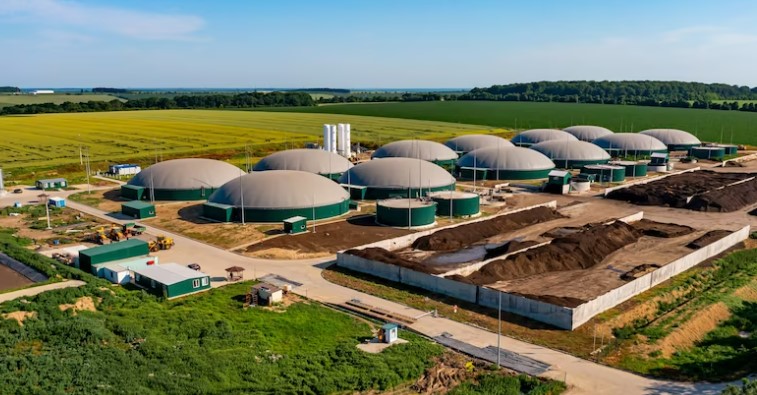
In an era when the world is striving to reduce its carbon footprint and transition towards sustainable energy sources,the biogas revolution stands out as a beacon of hope.Biogas,often dubbed”green gold,”is transforming the way we produce electricity while addressing critical environmental and waste management issues.
Biogas is a renewable energy source that’s generated through a natural process called anaerobic digestion.This process occurs when microorganisms break down organic matter in the absence of oxygen,producing a gas mixture primarily composed of methane(CH4)and carbon dioxide(CO2).This gas,biogas,is a clean-burning fuel that can be harnessed to generate electricity.During the biogas production process,a biogas analyzer is needed to monitor gas content.It uses advanced photoelectric sensing principles to detect and analyze methane(CH4),oxygen(O2),carbon dioxide(CO2),hydrogen sulfide(H2S)and other gases.For example,the OLGA2000 biogas online monitoring system can be widely used in gas monitoring in landfill biogas power plants,petrochemicals,coal mines and other scenarios,and can achieve remote data transmission.

How the Biogas Revolution Works
The biogas revolution is powered by anaerobic digesters,specialized facilities designed to facilitate the anaerobic digestion process on a large scale.Here’s a simplified overview of the steps involved:
- 1.Feedstock Collection:Organic materials such as agricultural waste,food scraps,sewage sludge,and energy crops are collected to serve as feedstock for the anaerobic digesters.
- 2.Digestion Process:The feedstock is introduced into the digester,which maintains the anaerobic environment required for the microorganisms to work their magic.Over time,these microorganisms break down the organic matter,releasing biogas as a byproduct.
- 3.Biogas Collection:The produced biogas,primarily methane,is captured and stored for further processing and utilization.
- 4.Gas Upgrading:Before being used for electricity generation,the biogas typically undergoes a cleaning and upgrading process to remove impurities such as hydrogen sulfide,moisture,and carbon dioxide.This step ensures that the biogas meets the necessary quality standards for efficient combustion.
- 5.Electricity Generation:The purified biogas is used as a fuel in gas engines or turbines,where it is combusted to produce mechanical energy.This mechanical energy is then converted into electricity using generators.
- 6.Utilization:The generated electricity can be used to power homes,businesses,industries,and even contribute to the grid,depending on the scale of the biogas plant.
The Environmental Impact
- 1.Greenhouse Gas Reduction:By capturing and utilizing methane emissions from organic waste,biogas plants actively reduce the release of methane,a potent greenhouse gas.This helps combat climate change and reduce overall greenhouse gas emissions.
- 2.Waste Management:Biogas plants effectively manage organic waste,reducing the environmental impact of waste disposal and landfill usage.
- 3.Renewable Energy:Biogas is a renewable energy source,derived from the continuous availability of organic materials.This reduces dependence on fossil fuels and supports a sustainable energy landscape.
- 4.Local Energy Production:Biogas plants can be established in various locations,promoting local energy production and reducing the need for long-distance energy transportation.
- 5.Circular Economy:Biogas plants contribute to a circular economy by converting waste into valuable energy and nutrient-rich digestate,which can be used as organic fertilizer.
As awareness of environmental issues grows and governments prioritize renewable energy sources,biogas is poised to play an even more significant role in the transition towards eco-friendly electricity generation.
 Manufacturer of biogas analyzer, landfill gas analyzer and extraction monitor, anaerobic digester gas analyzer